
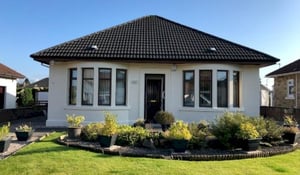
Living in a stone or granite property in Scotland is a point of pride for many homeowners. These buildings are iconic, but they come with a specific set of maintenance challenges — the most persistent of which is damp. In a climate where horizontal rain is a standard weather forecast, the porous nature of traditional stone can lead to significant moisture issues.

At LTI Transformations, we are often asked whether a wall coating can solve a damp problem. The answer depends entirely on the type of damp you are facing. While a professional wall coating is an excellent solution for many moisture-related issues, it is important to understand its role as part of a wider property care strategy.
Understanding The Types Of Damp
Before investing in any exterior treatment, it is essential to identify the source of the moisture. Exterior wall coatings are highly effective against one specific type of damp, but they are not a universal solution.
- Penetrating Damp: This is the most common issue for homeowners in Scotland. It occurs when wind-driven rain is absorbed directly into the masonry. Stone, brick, and traditional render are all naturally porous, and over time water seeps through, leading to damp patches on internal walls. A waterproof wall coating is specifically engineered to stop this process.
- Rising Damp: This occurs when groundwater travels upward through the walls via capillary action. It typically manifests as a tide mark near the skirting boards on the ground floor. Because this moisture originates beneath the building, an exterior wall coating cannot address it. Rising damp requires a specialist damp proof course (DPC) injection by a qualified contractor.
- Condensation: If you notice black mould in the corners of rooms or behind furniture, the problem is likely internal humidity rather than external water ingress. While a breathable wall coating can help by keeping walls warmer and drier, improving internal ventilation is the primary remedy for condensation.
How Micro-Porous Technology Protects Stone
Traditional stone properties were built to breathe. Historically, they were treated with lime-based products that allowed moisture to move freely in and out of the stone. Problems frequently arise when modern, non-breathable masonry paints are applied over this type of construction. These trap moisture inside the stone, leading to spalling — where the stone face fractures and crumbles during a freeze-thaw cycle.
This is where a breathable wall coating makes a critical difference. Our systems use micro-porous technology, which works on a simple but effective principle: the pores in the coating are small enough to prevent liquid water droplets from entering, yet large enough to allow water vapour molecules to escape from within.
This means that while the coating provides a robust waterproof barrier against rain and wind, it never traps internal moisture. That balance is essential for the long-term structural health of granite and sandstone properties across Scotland.
Scottish Stone, Cavity Walls, And Damp Ingress
Scotland's architectural heritage includes a significant number of solid stone walls and early cavity wall constructions. Granite, while exceptionally hard, often has mortar joints that deteriorate over time. Sandstone is even more absorbent, capable of drawing in substantial volumes of water during a wet winter.
In properties with cavity wall insulation, debris or trapped moisture within the cavity can create a pathway — known as a cold bridge — through which penetrating damp travels directly to the interior plaster. Applying exterior wall coatings to the outer leaf provides an essential first line of defence. By keeping the exterior masonry dry, you protect both the insulation and the internal structure from saturation.
Prevention Versus Cure: When To Call A Specialist First
It is important to understand that a wall coating is most effective as a preventative measure and as a solution for penetrating damp — not as a mask for more serious structural failure. If your property already has significant internal damp, a wall coating should be the final stage of the refurbishment, not the first.
You should consult a damp specialist before applying a wall coating if:
- You see tide marks on the lower half of your ground-floor walls.
- Your timber floorboards or skirting boards show signs of rot.
- There is significant salt crystallisation (white powder) on the internal masonry.
Once a specialist has resolved these underlying issues, a professional coating serves as a highly effective long-term barrier. It seals the building envelope, ensuring that once the walls are dried out, they remain so for decades to come.
Is Your Property Protected?
A wall coating addresses damp at its most common source: wind-driven rain penetrating the masonry. By investing in a high-quality, micro-porous system, you are not simply redecorating your home — you are creating a dry, warm, and structurally sound environment for your family.
If you have concerns about moisture in your stone property, we can help you identify the right course of action. Our free technical survey will assess your walls and confirm whether a wall coating is the appropriate solution for your home. Get in touch with the team at LTI Transformations today to book your assessment and take the first step towards lasting protection.
